Content Analyzer
Why isn't AI citing your content?
Your competitor's page passes the access, structure and authority checks AI engines run before they cite anyone. Yours is failing some of them — and you can't see which. Paste any URL and get an A–F citability grade, a live check of which AI engines cite the page, and the exact fixes.
Live AI-bot fetches + real engine checks · see plans
- D–FAI engines can't read or cite the page
- B–CReachable, but missing key citability signals
- AStructured to be cited
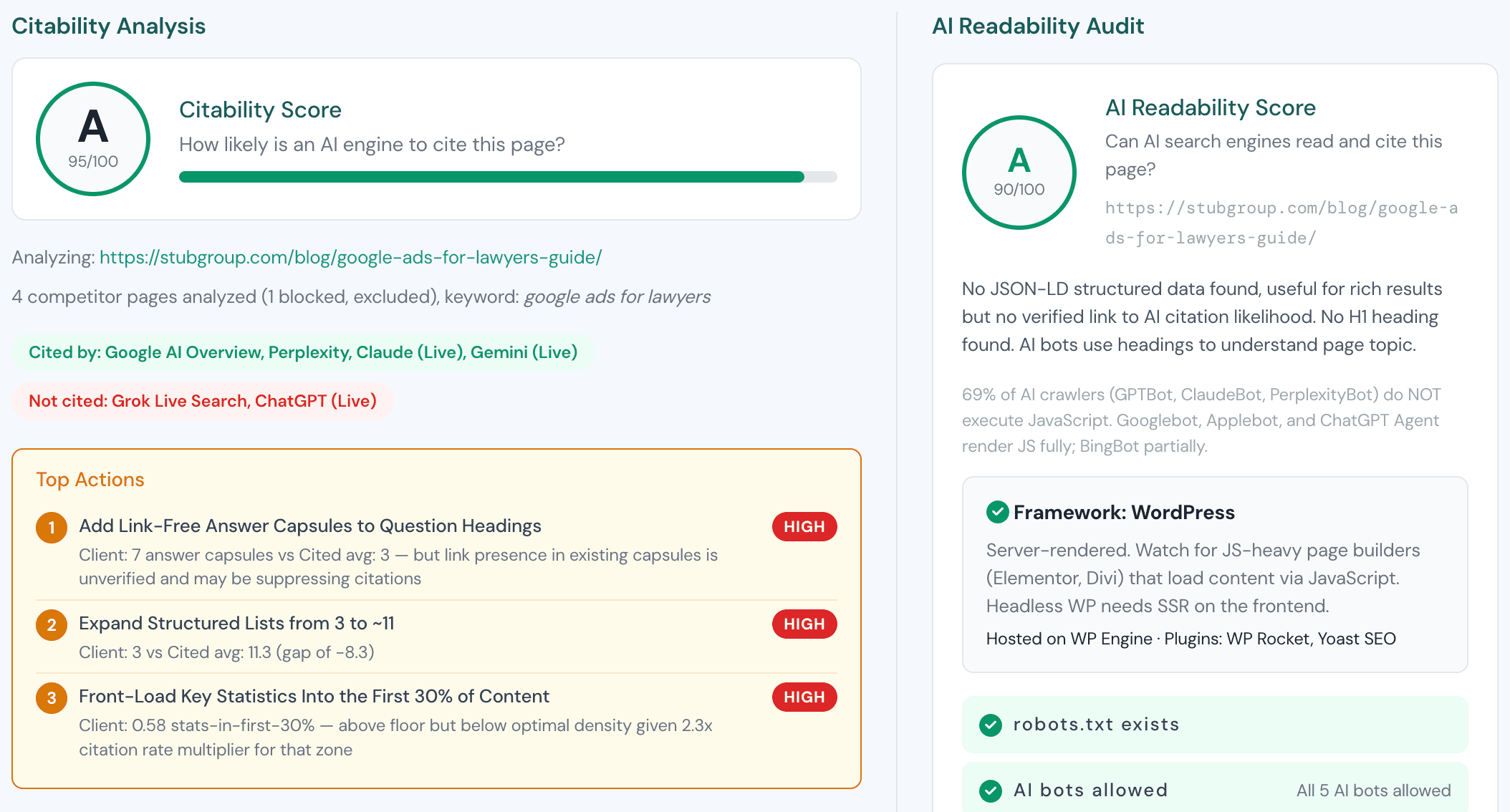
Each score is a letter grade backed by a 0–100 number, benchmarked against the pages AI actually cite for your keyword — the guide below scores 95 (Citability) and 90 (AI Readability).
The blind spot
You published a thorough guide. It ranks page one, it reads well, your team is proud of it. Then a buyer asks ChatGPT for the best option and it cites a thinner competitor instead — because that page front-loads its stats and yours buries them, or because Google-Extended is blocked in a robots.txt line nobody remembers adding. There's no error to catch. You just aren't in the answer.
Two things decide it: whether a crawler can read the page — 69% of AI crawlers never run your JavaScript, so a client-side-only page can be blank before a word is read — and whether your content gives an engine more to cite than the pages it already trusts. Content Analyzer checks both: it fetches your URL the way each engine does, checks live which ones already cite it, and benchmarks every signal against the pages they cite instead.
From URL to punch list in minutes
- 01 · Paste
Any URL + your keyword
Drop in your page, a competitor's, a PDP or a blog post, plus the keyword you want to be cited for. It handles static HTML, server-rendered, and client-rendered React.
- 02 · Analyze
Two scores, checked live
It fetches the page as each AI bot, diffs the JS vs no-JS render, and checks live which of six AI engines cite it. Then it pulls the pages those engines do cite and benchmarks yours against them, signal by signal.
- 03 · Fix
A prioritized punch list
You get a Citability and an AI Readability grade, the HIGH-impact actions with the gap quantified, and a one-click content brief to rewrite against. Hit Rerun to watch the grade move.
In-house SEO
Find the exact signal keeping a page that ranks out of the AI answer.
Agency
Grade a client's page, export the PDF, and attach the proof to the proposal.
Content lead
Turn the gap into a brief your writer can execute the same day.
Two scores, every signal shown
Citability is the writing. Readability is the access.
A page can be perfectly written and still invisible to AI because a crawler can't reach it — or perfectly reachable and never cited because the content gives an engine nothing to lift. Content Analyzer grades both, and every signal below is in the report.
Citability signals
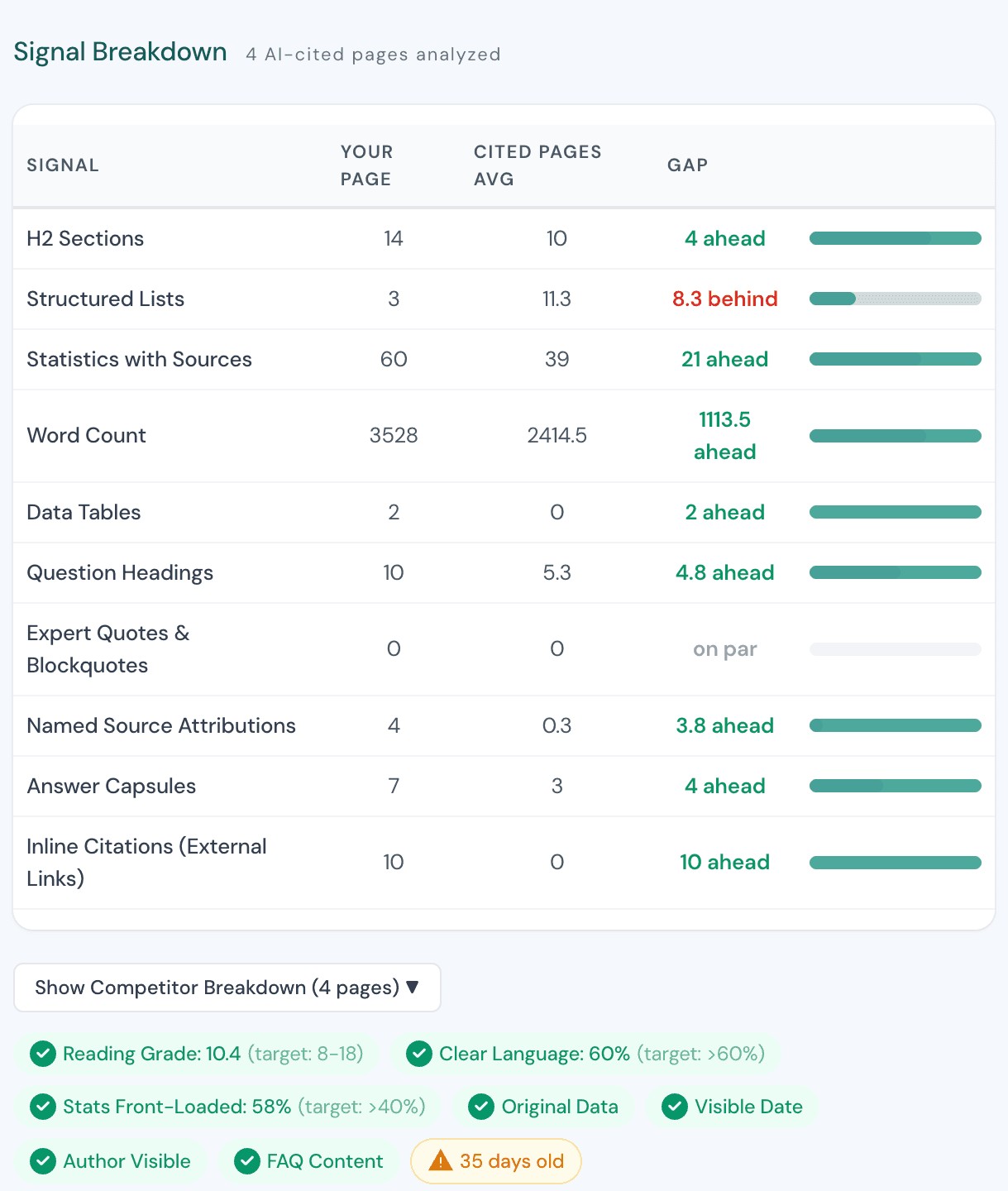
vs the pages AI citesBenchmarked against the AI-cited pages for your keyword — each shown as ahead, on par, or behind.
- Answer capsules — Short, link-free answers right under a question heading — the snippet AI lifts verbatim.
- Question headings — H2/H3s phrased as the questions buyers actually ask an AI engine.
- Structured lists — Numbered and bulleted lists AI can extract as steps or options.
- Statistics with sources — Quantified claims with a named source AI can trust and repeat.
- Named source attributions — “According to [org]…” attributions AI treats as authority.
- Inline citations — Outbound links to primary sources that signal a researched page.
- Data tables — Comparison and spec tables AI parses into structured answers.
- Expert quotes — First-hand expert voice and blockquotes AI weighs as experience.
- H2 coverage & word count — Topic breadth and depth, measured against the cited pages — not a vanity number, a gap.
- Stats front-loaded — How much of your evidence lands in the first 30% — the zone AI reads first.
- Reading grade & clarity — Plain-language scoring; dense prose is harder for AI to quote cleanly.
- Freshness & author — Visible date, days since update, and a named author — all E-E-A-T signals.
Plus the editorial chips AI weighs: reading grade, clear-language %, stats front-loaded %, original data, visible date, named author, FAQ content, and days since the last update.
AI Readability checks
can a crawler read itWhat an AI agent receives when it fetches the page — access, render parity, and structure. To clear access blocks across your whole site first, run Agent Readiness.
- AI bot access — robots.txt checked against the major AI crawlers — and the source line of any block.
- JS vs no-JS parity — We render with and without JavaScript and diff the word counts; 69% of AI crawlers don't run JS.
- JSON-LD structured data — Whether schema is present, well-formed, and type-correct.
- H1 & heading structure — An AI engine uses your H1 and headings to understand the page's topic.
- Title & meta description — Present, sensible length, and descriptive of the actual content.
- Image alt + real src — Alt-text coverage, plus images that load from a real src — not lazy-JS an agent never sees.
- Render-blocking & Core Web Vitals — Blocking scripts, LCP, CLS and TTI on the rendered page.
- Open Graph & internal links — OG tags, and how many internal links survive without JavaScript.
- Framework & host detection — WordPress, the CDN, and the plugins in play — so the fix targets the right layer.
Live AI-bot fetches + real engine checks · see plans
It doesn't infer. It checks.
Which AI engines cite the page — live, per engine.
Most tools estimate AI visibility from training-data patterns. Content Analyzer queries each engine live and tells you, for this URL, exactly who cites it and who doesn't — so you know whether to fix the content, clear an access block, or both. Pair it with GEO Scan to see whether AI engines cite you for a whole keyword set.
Checked live for every analysis — cited or not cited, per engine
- ChatGPT
- Perplexity
- Gemini
- Claude
- Google AI Overviews
- Grok
Act, don't just monitor
Most AI-visibility tools show you the gap and stop. Content Analyzer runs the fix.
A domain-level dashboard tells you your share of voice is down. It can't tell you which line on which page to change. Content Analyzer ends every run with a prioritized, per-signal action list — the exact change, header, or section to add — and a one-click brief built from those gaps.
See ‘Structured lists: 3 vs a cited-page average of 11’? That becomes a HIGH action with the target count, then a content brief you can write straight against — and a Rerun to confirm the grade moved.
Turn the fixes into a citation-ready draft in Content StudioWhat makes it different
Not another “SEO score.”
Benchmarked
Graded against what's already winning
We don't grade you against a generic ideal. Content Analyzer pulls the pages AI actually cites for your keyword and shows you, signal by signal, where you lead and where you trail — so the fix list is grounded in what's already getting picked up, not a checklist.
Per-engine, live
Which engines cite it — checked, not guessed
ChatGPT, Perplexity, Claude, Gemini, Google AI Overviews and Grok, queried live. You see exactly which cite the page today and which don't, so you know whether you have a content problem or an access problem before you touch a thing.
Access + content
The block and the writing, in one pass
A blocked GPTBot or a JS-only page keeps you out no matter how good the prose is. Content Analyzer checks robots.txt, the AI bots, JS-render parity, schema and H1 in the same run as the content signals — and names the source of any block so you loop in the right developer.
Gap → draft
Ends in a brief, not a to-do
Every analysis closes with a prioritized action list and a one-click content brief built from the exact gaps it found, so the next thing you do is write against the fixes, not stare at a score.
Re-runnable
Prove the fix shipped
Every analysis is stored. Ship a change, hit Rerun, and the grade moves — an audit trail you can hand a developer, a client, or your CMO.
Exportable
A report you can attach to a proposal
Download the full grade, the per-engine cited-by, the signal benchmark and the readability matrix as a PDF. Clean enough to send to a client, detailed enough to hand to a developer.
Where it fits
A performance score and a visibility dashboard answer different questions.
Content Analyzer works at the page level. To see every cited and uncited page across your whole domain, pair it with Domain Overview.
| Lighthouse / PageSpeed | Profound / Otterly / Peec | Content Analyzer | |
|---|---|---|---|
| Audits one URL's on-page signals | SEO/perf only | ||
| Checks AI-bot access + JS-render parity | |||
| Live per-engine cited / not cited for the page | Domain-level | ||
| Benchmarks signals vs the pages AI cites | |||
| Exact per-signal fix list | |||
| Generates a content brief to close the gap |
Lighthouse grades performance for Google and humans; domain-level monitors like Profound and Otterly track your whole site's share of voice over time. Only Content Analyzer audits a single URL the way AI reads it, benchmarks it against the pages AI cites, and hands you the fix.
Already cited by Google AI Overview, Perplexity, Claude and Gemini — Content Analyzer flagged the one gap (3 structured lists vs an 11.3 cited-page average) keeping the page out of ChatGPT and Grok.
Queried live across the engines your customers actually use
- ChatGPT
- Perplexity
- Gemini
- Claude
- Google AI Overviews
- Grok
Every grade comes from a live fetch of your real URL — the page rendered in a headless browser and probed as the AI crawlers, then benchmarked against the pages those engines actually cite. No cached guesses, no training-data inference.
FAQ
Frequently asked
- 01What does the Citability Score actually measure?It's a grade from A to F (backed by a 0–100 score) for how likely an AI engine is to cite the page. It rolls up the on-page signals AI engines reward — answer capsules, question headings, structured lists, sourced statistics, data tables, freshness — and benchmarks each one against the pages those engines actually cite for your keyword. Alongside it, a separate AI Readability grade covers whether a crawler can even reach and render the page. Two scores, because being citable and being readable are two different problems.
- 02Will fixing these signals actually get me cited by ChatGPT and Perplexity?There's no guarantee — AI citation is probabilistic. But the benchmark isn't a generic ideal: it's measured against the pages those engines are already citing for your exact keyword, so closing the gaps moves you toward what's demonstrably winning. And because Content Analyzer checks each engine live, you can ship a fix, hit Rerun, and watch whether a 'not cited' flips to 'cited' — instead of guessing.
- 03How is this different from a Lighthouse or SEO audit?Lighthouse grades performance and technical SEO for Google and human visitors. Content Analyzer grades AI citability — answer engine optimization (AEO): it fetches your page as the AI bots, diffs the JS vs no-JS render the way a non-JS crawler sees it, and benchmarks your content signals against the pages AI cites. Different question, different output — a green Lighthouse score tells you nothing about whether ChatGPT can read or will cite you.
- 04What's the difference between Content Analyzer and GEO Scan?GEO Scan asks whether AI engines currently cite your brand for a keyword — a live visibility check across a prompt set. Content Analyzer zooms into a single URL to explain why that page is or isn't citable and hand you the fix. Use Scan to measure where you stand, Analyzer to fix the page that's falling short.
- 05Does it check whether AI bots can actually crawl my page?Yes — and that's a separate check from the per-engine citation result. The AI Readability module is an AI crawler checker and a robots-txt-for-AI audit built into every page grade: it probes your page against the major AI bot user agents — GPTBot, ClaudeBot, PerplexityBot, Google-Extended and CCBot — and reports which are blocked and where the block lives: robots.txt, an X-Robots-Tag header, an llms.txt directive, or a CDN firewall rule. It also diffs the JS and no-JS render, because most AI crawlers don't execute JavaScript.
- 06Does it need access to my analytics or account data?No. Content Analyzer only fetches publicly accessible URLs — the same way an AI crawler would. It never needs your analytics, your CMS, or your account data to grade a page.
- 07Can I export the analysis as a report?Yes. Every analysis downloads as a PDF with the full grade, the per-engine cited / not-cited result, the signal benchmark, the AI-readability matrix and the prioritized fixes. Clean enough to attach to a proposal, detailed enough to debug.
- 08What does Content Analyzer cost?Content Analyzer is included from the Starter plan ($49/mo) up. A free account covers the AI visibility tracker and Agent Readiness so you can start without a card — see the pricing page for current tiers.
Grade your first page.
Results in minutes.